
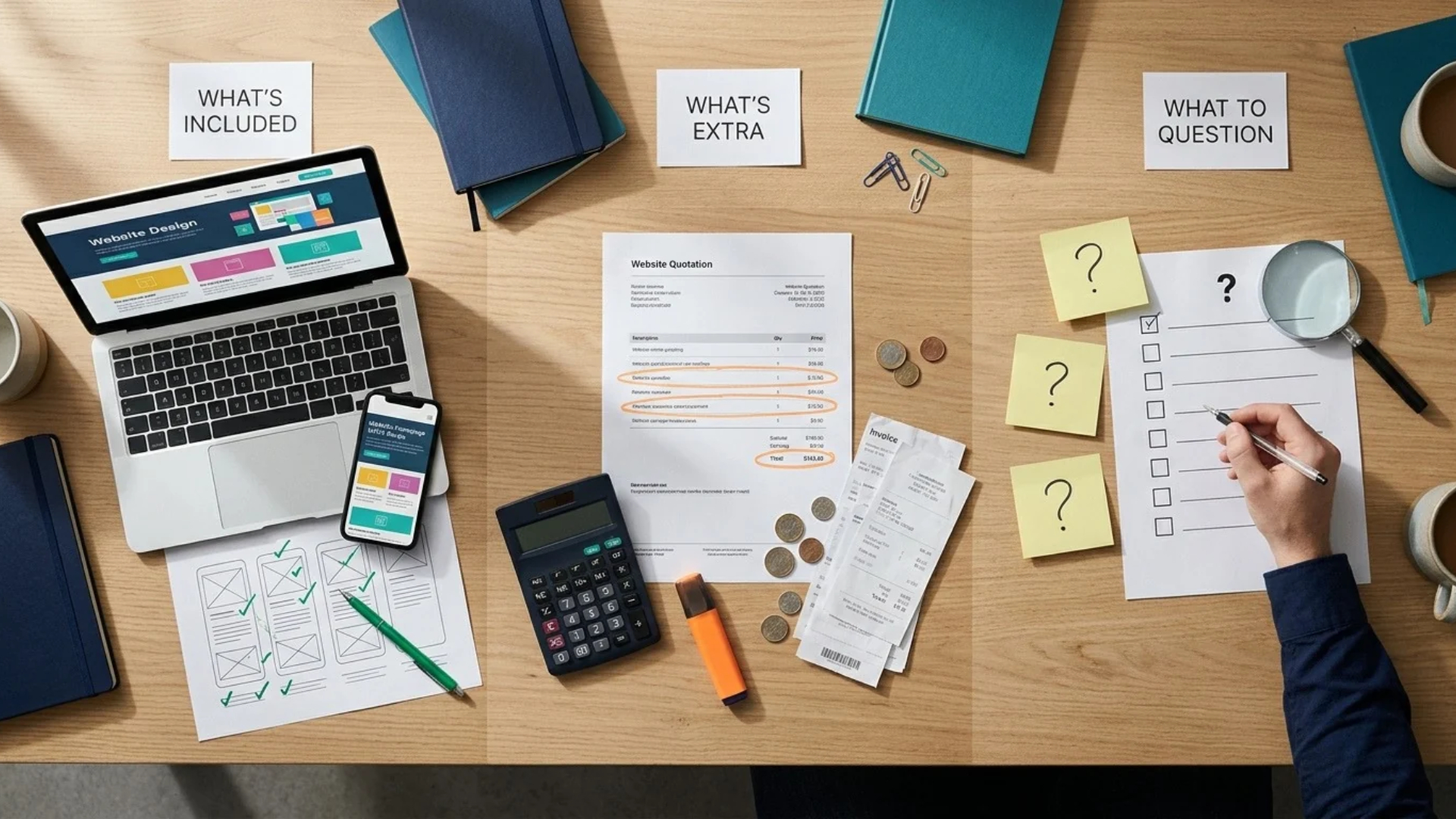
You have three quotations on your desk. One line on each says “website design and development”, followed by a price. They look comparable, so you choose the middle option and move on.
A few weeks later, the questions start. Who is writing the content? Why is hosting a separate invoice? Why does the booking feature you mentioned in the first meeting now need a “change request”?
This is one of the most common frustrations businesses face when buying a website. The problem is rarely the price itself. It is that website design and development services can mean very different things from one provider to the next, and a quotation that does not spell out its scope leaves room for expensive assumptions.
This guide explains what a quotation normally includes, what agencies often charge extra for, and the questions to ask before you sign anything.
What Are Website Design and Development Services?
Website design and development are two connected disciplines. Agencies often sell them together; however, each one involves different skills.
Website design is about how the site looks and how people use it. It covers layout, navigation, typography, colour, visual hierarchy and user experience (UX). A designer decides where the most important information sits on a page, how a visitor moves from the homepage to an enquiry form and how the site adapts to a smaller screen.
Website development turns those designs and requirements into a working website. Developers write the code, configure the content management system (CMS), connect forms and databases, integrate third-party tools and make sure everything performs reliably.
Put simply, design decides what the experience should be, and development makes that experience work. When a quotation bundles both under one line, your job is to find out exactly how much of each you are getting.
What Do Website Design and Development Services Normally Include?
There is no industry standard package, but most professional quotations for a business website cover the following areas in some form.
Website Planning and Requirements
Good projects start with understanding your business objectives, target audience, the pages you need and the functionality the site must support. At this stage, you and your provider decide on site structure, key user journeys and calls to action.
The depth of this stage varies widely. Some providers run a detailed discovery phase, while others rely on a short questionnaire. If you are still unclear about what your site needs to do, spending time on defining your website requirements before requesting quotations will make every proposal easier to compare.
Website UI/UX Design
User interface (UI) and user experience design covers page layouts, navigation menus, visual hierarchy and how interactive elements behave. A quotation should tell you whether you are getting custom designs for each page type or a design applied to a pre-built theme.
Also, check how many design concepts and revision rounds the quotation includes. “Unlimited revisions” sounds generous but is rarely realistic, and a vague revision policy can lead to disputes later.
Front-End Development
Front-end development is everything visitors see and interact with in their browser. Developers convert approved designs into functional pages using code, building menus, sliders, forms, buttons and other interactive elements so they behave consistently.
Back-End Development and CMS
Meanwhile, back-end development handles what happens behind the scenes. This may include setting up a content management system such as WordPress, configuring databases, building custom functionality and connecting integrations such as a CRM, booking tool or email marketing platform.
A CMS lets your team edit text, add pages and publish updates without a developer. Make sure the quotation confirms which CMS the provider will use and whether you will receive basic training on how to use it.
Responsive Website Development
Responsive development means the site adapts to desktops, tablets and mobile phones. For most businesses, a large share of visitors will arrive on a phone, so this should be a standard inclusion rather than an optional extra. Still, confirm that the team designs and tests responsive behaviour for every page type, not just the homepage.
Basic Technical SEO Considerations
A well-built website should give search engines a solid foundation. That typically includes:
- Crawlable page structure and logical heading hierarchy
- SEO-friendly URLs
- Fields for page titles and meta descriptions (and sometimes their implementation)
- Mobile usability
- Sensible attention to page speed, such as optimized images and clean code
What this does not usually include is a full SEO campaign. Keyword research, content strategy, link building and ongoing optimization are separate services. A developer who builds a technically sound site has given you a good starting point, not guaranteed rankings.
Testing and Website Launch
Before launch, a professional provider should check that forms submit correctly, links work, navigation behaves as expected and pages display properly across major browsers and screen sizes. Launch preparation usually covers moving the site to its live server, connecting the domain and confirming that analytics tracking is in place.
Standard testing is different from specialist work such as formal accessibility audits, penetration testing or load testing for high-traffic sites. Therefore, if you need those, expect a separate scope. We will cover the website development process from brief to launch in more detail in a dedicated guide.
What Do Agencies Usually Charge Extra For?
This is where most misunderstandings happen. The items below are common additional costs, not universal exclusions. Some agencies include several of them in their packages, which is exactly why you need to read each quotation carefully.
Common Additional Costs at a Glance
| Item | Why it is often separate |
|---|---|
| Domain registration | You register it in your name and renew it annually |
| Hosting | An ongoing service with recurring monthly or annual fees |
| Premium themes and plugins | Third-party products, often with annual licence renewals |
| Paid software licences | Booking systems, form builders or CRM tools charge their own fees |
| Professional copywriting | Writing persuasive, search-friendly content is a separate skill |
| Photography and video | Custom shoots or stock licences cost extra |
| Advanced custom functionality | Calculators, portals and bespoke tools require extra development time |
| Third-party integrations | Connecting complex systems often needs custom work and testing |
| E-commerce payment charges | Payment gateways charge transaction fees directly to you |
| Ongoing SEO | A continuing marketing service, not part of the build |
| Maintenance plans | Updates, backups and security monitoring after launch |
| Ongoing content updates | Edits beyond any agreed post-launch support window |
| Additional pages | Pages beyond the agreed count usually cost extra |
| Multilingual functionality | Translation, extra templates and language-switching setup |
Three Extras That Often Catch Businesses Out
However, a few of these deserve a closer look.
Content comes first. Businesses most often assume it comes as standard, yet agencies most often leave it out. If the quotation says “content population”, that usually means the agency will add your supplied text and images to the pages. It does not mean they will write them.
Payment gateway fees apply to anyone selling online. Even with a fully built shop, the payment provider takes a fee on each transaction. This is a cost of trading, not a development cost, and it is one of several factors we look at in our upcoming guide to e-commerce website design and development.
Finally, many people confuse ongoing SEO with the technical SEO foundations described above. If you want your site to attract organic traffic consistently, that work usually sits within wider digital marketing support rather than the website build itself.
Website Design vs Website Development: Why You Need Both
It is possible to have a beautiful website that performs badly, and a technically excellent website that nobody enjoys using.
Picture a local accountancy firm with a striking new homepage. The design looks polished, but the contact form occasionally fails to send, pages take several seconds to load on mobile and the CMS is so awkward that staff stop updating it. The visual design did its job. The development did not.
Now reverse it. A trades business has a fast, secure site with reliable forms, but the navigation is confusing and the phone number sits at the bottom of each page. Everything works, yet visitors cannot quickly find what they came for.
Both scenarios lose enquiries. As a result, strong results come when your provider makes design and development decisions together, which is why many businesses prefer coordinating website design and development through one team rather than splitting them between separate providers. We will explore more of these pitfalls in our guide to common business website development mistakes.
Questions to Ask Before Accepting a Website Development Quotation
These questions help you uncover what a quotation really covers. Ask them in writing and keep the answers with your contract.
Scope, Design and Content
- How many pages does the price cover? Page count directly affects design and build time. Ask what happens if you need more and how the provider prices additional pages. Scope changes like this are also one of the main factors behind custom website development timelines.
- Does the price cover website content? Clarify whether the provider will write content, only upload what you supply, or neither.
- Is the design custom or template-based? Both can be valid, but they carry different costs, flexibility and long-term limitations. Understanding custom-built websites versus template-based solutions helps you judge whether the price fits what you are getting.
- Is the website responsive? Above all, confirm that the team designs and tests every page type on mobile and tablet.
Technology, Hosting and Testing
- Which CMS or technology will you use? This affects how easily you can manage the site and how freely you could move to another provider later.
- Does the quote cover integrations? List the tools you use, such as your CRM, booking system or newsletter platform, and ask which ones the quote covers.
- Does the quote cover domain and hosting costs? If so, for how long, and what happens at renewal?
- Does the build include basic technical SEO? Ask exactly which elements, so you know where the build ends and marketing begins.
- What testing will you carry out before launch? Ask which browsers and devices they test on and whether they check forms and integrations end to end.
Ownership, Support and Ongoing Costs
- Who owns the website and its source files? You should own your domain, content and, ideally, the site itself. Check for any licensing restrictions.
- Does the price include maintenance after launch? Many quotations include a short support window. Ask what it covers and what it costs afterwards.
- What happens if I request additional functionality? A clear change-request process protects both sides from disputes.
- Are there any recurring third-party costs? Plugins, licences and software subscriptions can add up. Therefore, ask for a full list.
How to Compare Website Design and Development Quotations
Once you have answers, you can compare quotations properly. Start with scope, not the headline price.
Line up the deliverables. Put each quotation side by side and list pages, design work, functionality, integrations, testing and post-launch support. As a result, gaps become obvious quickly.
Check page limits and functionality. A lower price for ten pages is not cheaper than a higher price for twenty if you need twenty. The same applies to features.
Review ownership terms. A low upfront price paired with restrictive ownership or a proprietary platform can cost more if you ever want to move.
Add up recurring charges. For example, hosting, licences and maintenance plans can change the true cost significantly over several years.
Compare post-launch support. Find out how quickly issues will be fixed and whether the provider includes updates or bills them separately.
Look for exclusions. Finally, a trustworthy quotation sets out its exclusions as clearly as its inclusions.
The cheapest option may not offer the best value if it leaves out work you will need to pay for later. Equally, an expensive quotation is not automatically better. Value comes from a scope that matches your needs. The type of provider matters too, and choosing between a freelance website developer and an agency is a decision that deserves its own consideration, as does choosing a professional website development company in Glasgow.
How to Find the Right Website Solution for Your Business
The right solution depends on your business objectives, target audience, required functionality, budget, plans for growth, integration needs and how much of the site your team will manage day to day.
For example, a well-structured CMS website may suit a small service business that mainly needs credibility and enquiries. A business with unusual workflows, complex integrations or plans to build customer portals may need custom development. Many businesses sit somewhere in between, and WordPress development for business websites can offer a practical balance of flexibility and ease of management when a developer sets it up properly.
If you already have a site, the question may not be what to build but whether to rebuild. Knowing when your business needs a website redesign can save you from spending money on a new site too early or holding on to an old one for too long.
Website Design and Development Services at Digitsea
Digitsea is a digital marketing agency based in Glasgow, working with businesses across the UK. Our website design and development services cover custom website development, WordPress development, e-commerce builds, UI/UX design, responsive design, speed and performance optimization, and ongoing maintenance and support.
Our developers, designers and marketers work together, so we plan the way your site looks, functions and supports your marketing as one project rather than three. Every project begins with understanding your customers and goals, and we set up analytics so you can see how the site performs after launch.
Because every business needs something different, we do not believe in one-size-fits-all packages. We provide a clear, no-obligation quotation that sets out exactly what the work covers, so you know exactly what you are paying for before work begins.
If you are planning a new website or upgrading an existing one, get in touch to talk through your requirements.
Final Thoughts
A website quotation is only as useful as the scope behind it. Two prices for “website design and development services” can describe completely different projects, and the difference usually only becomes visible once work has started.
Before you commit, find out what the price covers, what will cost extra and what happens after launch. Ask the questions above, compare deliverables rather than headline figures and make sure ownership and recurring costs are clear.
Transparent scope leads to realistic expectations, fewer disputes and a website that does what your business needs. If you would like a clear, itemized view of what your website project involves, speak to the Digitsea team today.


Custom Website Development Services: Realistic Timelines
November 19, 2026[…] the same core stages. If you want to know which stages a quotation normally covers, our guide to understanding website development deliverables explains what to expect. The website development process from brief to launch deserves a detailed […]